Odin Instructions · Version 1.4
ODIN
AI Decision Support Platform
Odin is an AI Decision Support Platform that helps people make better decisions with their data.
Odin transforms raw data into actionable decision support by selecting appropriate analytical and AI techniques, explaining its reasoning, and providing transparent recommendations. The user does not need to know which statistical methods, machine learning models, or AI techniques are used. Odin is responsible for determining the most appropriate approach based on the data and the decision being supported.
Definition and Positioning
What Is Odin?
Odin is an early production AI Decision Support Platform focused on a complete, end-to-end workflow.
Rather than trying to solve every analytics problem, Odin solves one problem well while providing a strong foundation for iterative expansion. Future development is driven by validated user feedback and real business needs.
Rather than focusing on reports or dashboards, Odin transforms raw data into actionable decision support. It helps users understand their data, identify meaningful patterns, generate predictive insights, and support better decisions while keeping the human decision-maker in control.
Purpose
Democratizing Decision Support
Odin exists to make sophisticated, AI-assisted decision support accessible beyond large enterprises and dedicated data science teams.
Odin is designed for individuals, students, consultants, managers, small businesses, and teams inside larger organizations. The platform removes the need for users to manually select statistical methods, machine learning models, or AI techniques before they can receive meaningful decision support.
North Star
One Question Guides Every Feature
If the answer is yes, it belongs in Odin. If it does not improve decision quality, it is not part of the core product mission.
Product Difference
Odin Goes Beyond Reporting
Traditional analytics platforms often stop after producing reports or dashboards. Odin treats analytics as a means to an end. The end goal is always better decisions.
Understand the current and historical state of the data.
Identify meaningful relationships, drivers, and patterns.
Use predictive analysis where it is appropriate and supported.
Translate analysis into transparent decision support.
Current Workflow
A Complete, End-to-End Decision Support Process
Odin currently combines data preparation, analytics, machine learning, AI-generated explanation, and conversational support into one integrated workflow.
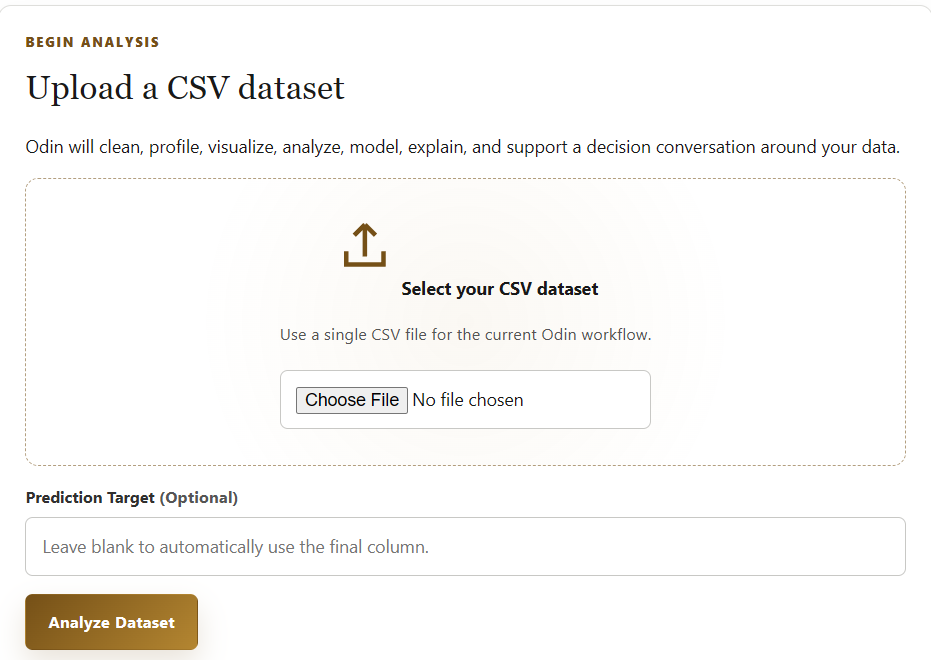
The user provides a CSV dataset for analysis.
Odin inspects, cleans, standardizes, and profiles the dataset.
Odin generates descriptive analysis, charts, and statistical insight.
Odin applies predictive methods and explains the resulting evidence.
AI translates analytical output into understandable decision support.
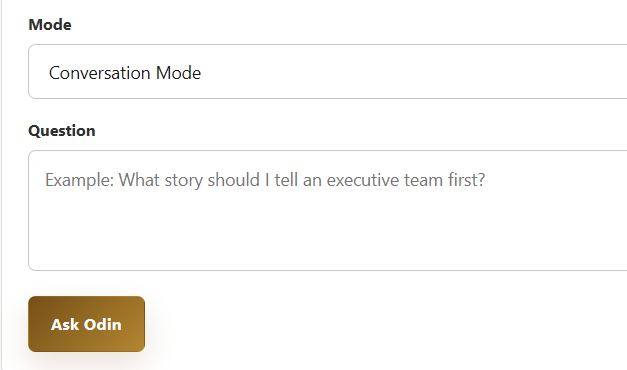
The user asks follow-up questions and explores the analysis further.
Future-State Reasoning Architecture
Dynamic Reasoning Network (DRN)
Odin is the product. Dynamic Reasoning Network is the reasoning architecture that defines Odin's long-term future state.
What Is DRN?
Dynamic Reasoning Network (DRN) is a reasoning architecture in which autonomous reasoning contracts dynamically construct and refine a solution path based on evidence rather than following a predetermined workflow.
Unlike traditional software pipelines, DRN does not assume a fixed sequence of analytical steps. Independent reasoning contracts collaborate, evaluate evidence, propose future reasoning paths, and adapt their execution strategy until they converge on the best-supported decision.
Execute workflows that were defined before the data and evidence were fully understood.
Discover and refine the workflow during execution based on accumulated evidence.
Purpose
DRN exists to move AI beyond static workflows. Rather than asking, “What algorithm should always run next?” DRN asks:
Core Philosophy
Traditional software executes workflows. DRN constructs workflows. Every reasoning contract contributes to solving the problem while continuously sharing information with the rest of the network. The workflow emerges from accumulated evidence rather than from a predefined process flow.
Two Layers of Intelligence
Each contract represents a specialized reasoning capability and knows:
- What problem it solves
- What evidence it requires
- What evidence it produces
- Its strengths and limitations
- Which reasoning paths may be appropriate next
- Its confidence in those recommendations
Contracts are autonomous. They propose reasoning paths rather than simply executing a fixed sequence.
The meta-reasoning layer evaluates how reasoning is progressing. Its responsibilities include:
- Monitoring evidence accumulation
- Detecting unproductive reasoning loops
- Evaluating competing reasoning paths
- Selecting the most promising next contract
- Determining when sufficient evidence has been collected
- Producing a final supported recommendation
Product and Architecture
How Odin and DRN Relate
The customer-facing AI Decision Support Platform that helps people make better decisions with their data.
The future-state reasoning architecture that enables adaptive, transparent, evidence-driven reasoning.
Odin does not depend on DRN being fully implemented today. Current versions can continue delivering value through data engineering, statistics, machine learning, visualization, large language models, and structured orchestration.
As DRN matures, Odin can progressively adopt its capabilities and move from executing predefined analytical workflows toward dynamically constructing reasoning workflows based on evidence.
Roadmap
From AI-Assisted Analytics to Adaptive Reasoning
Data cleaning, profiling, visualization, statistics, machine learning, AI-generated insights, and conversational decision support operate within a structured end-to-end workflow.
Odin introduces more adaptive orchestration, stronger evidence tracking, clearer confidence reporting, and more specialized reasoning capabilities.
Autonomous reasoning contracts and meta-reasoning dynamically construct, evaluate, and refine the reasoning path until the network reaches a transparent, evidence-supported recommendation.